
Sensing meets Action
Aerospace; Oil and Gas; Mining; Telecommunication; Medicine; and the Military Complex are just some of the primary drivers of the technologies of sensing and measurement, ranging from Magnetic Resonance Imaging, Induction, Seismic, Sonic and Infrared. As each new technology finds new applications, a bigger market, as it attracts further investments, it becomes ever more accessible and affordable.
Today the investments and ambition towards driverless cars, robotics, coupled with advances in machine learning, artificial intelligence, is further accelerating this technological change. And then there is tomorrow, which brings with it the possibilities and promise in the area of quantum sensing and quantum computing, the possibility of going beyond the bounds of current classical systems.
At MyraCeph we look to explore the possibilities of these technologies; to explore new applications; the coupling of sensing with software, as we envisage and explore the world of tomorrow while looking to address some of the challenges of today.
What’s in a Name?
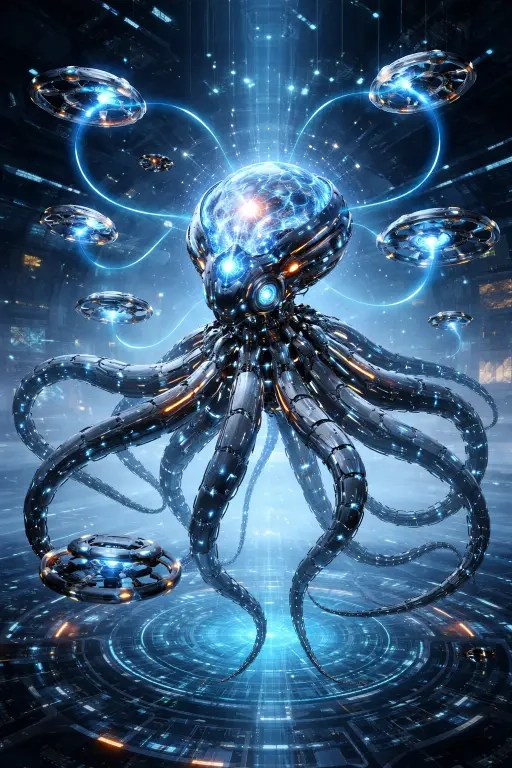
Cephalopods — octopuses, squids, and cuttlefish — possess one of the most extraordinary nervous systems in the animal kingdom. Rather than routing all sensation and motor control through a centralized brain, roughly two-thirds of their neurons are distributed across their arms, each of which can sense, react, and make decisions quasi-independently. An octopus arm can withdraw from a painful stimulus, navigate a maze, or manipulate an object without any instruction from the central brain — the arm, in a very real sense, thinks for itself. This architecture is strikingly analogous to modern distributed computing and robotics, where the paradigm of a single, all-knowing central processor has given way to networks of smart sensors and edge-computing nodes. A robotic limb today need not wait for a distant controller to tell it the floor is uneven — onboard intelligence senses, interprets, and responds locally, just as a cephalopod arm does. Intelligence, both biological and artificial, is increasingly something that lives at the periphery.
When these semi-autonomous systems are connected into a larger whole, their collective capability becomes something qualitatively new. While in the natural world sensing is what evolution has granted it, a robotic sensor array can perceive far beyond the biological envelope — seeing in infrared, mapping space with lidar, detecting magnetic fields, or sampling chemical gradients at sensitivities no organism has ever evolved. And where the nervous system of even the most complex animal is constrained by the electrochemical speed of axonal transmission and the narrow bandwidth of touch, vision, and sound, networked robotic systems communicate at the speed of light across channels of essentially limitless bandwidth, sharing not impressions but raw data in full fidelity. The convergence of distributed intelligence, superhuman sensing, and high-speed interconnection is compressing what would have been centuries of incremental capability into a single generation.
That compression arrives carrying two futures simultaneously: one in which the concentration of such power — produces consequences that are difficult to imagine and harder to reverse; and another in which the same architecture of connected, sensing, thinking systems dissolves problems that have defeated humanity for millennia. Which future unfolds may depend less on the technology itself than on the wisdom — distributed or otherwise — of those who seek to understand and shape it.